
A total of 22,27,506 farmers have obtained loan of about Rs 10,736 crore from cooperative banks in the state.

'It is a fiercely fought battle, like our fiery chillies in Guntur.'

Twenty-four more people were killed on Saturday as floods triggered by heavy monsoon rains inundated northern Pakistan, raising the overall death toll in the flooding to 46.

With over 8.69 lakh people still in 2,287 relief camps, it is a subdued 'Onam', the harvest festival, in the state.

Banks to be permitted to raise long-term funds for lending to infrastructure sector with minimum regulatory pre-emption such as CRR, SLR and Priority Sector Lending.

More than 50 people have been killed and over two lakh others affected by the floods caused by torrential rain across Pakistan, officials said on Monday.

Banks have started refunding borrowers the compound interest charged on specified loan accounts during the moratorium period. Last week, the Reserve Bank of India (RBI) had asked all lending institutions, including non-banking financial companies, to ensure that the scheme of waiver of interest on interest for loans up to Rs 2 crore for the six-month moratorium period is implemented by November 5.

Finance Minister Nirmala Sitharaman on Thursday announced a Rs 11.11 lakh crore spending on infrastructure and vowed to continue reforms as she resisted resorting to populist measures in Modi government's last Budget before general elections, instead choosing to stay on the path of cutting deficit while bolstering measures for focus groups.
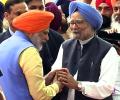
Whether it was the MGNREGS or the NFSA or the Aadhaar-based DBT scheme for cash transfer, the Modi government has built on the basic architecture created by the Singh government. Policy makers in the Modi government, instead of discarding them as products of the previous political regime, worked on them, expanded their scope and reach, and used new tools to improve their performance, explains A K Bhattacharya.

Fadnavis assured them of transferring land rights within the next three months.

An estimated 223 people have lost their lives since August 8 in Kerala's worst floods in decades that has caused damage worth more than Rs 20,000 crore.

Thackeray also claimed that the Maharashtra government is yet to receive a total of around Rs 38,000 crore from the Centre.

Sachin P Mampatta goes back in time to recall a deluge that that has passed into lore in Kerala.

The middle class is a big force to fulfil dreams of a prosperous and developed India and our government has taken many decisions to empower it, the prime minister said.

Flood in the rice bowl: Keralites who lost everything stare at uncertainty.

Prof Ananth Narayan, well known financial expert who works as a faculty member at the SP Jain Institute of Management and Research and the RBI's nominee director on the board of Yes Bank, expects a double-digit contraction in India's GDP this fiscal year. In the first of a two-part interview to Shobha Warrier/Rediff.com, Prof Narayan, below, says, "Giving liquidity and loan to cover the cash flow problem is not sufficient because you are essentially increasing the debt of many of these companies. And they might not be able to bear the burden."

Later, there may be some tax relief aimed at the middle class and measures to benefit the sectors worst hit by Covid-19 and the resultant nationwide lockdown.

Robust procurement of paddy and wheat since 2017 and prompt payment to farmers have helped the UP government cultivate a positive and pro-farmer perception, defusing possible farm face-off situations.

For all its claims to economic glory, the majority of India's population lives vulnerable lives, a situation that has only worsened over the past 15 years, to the extent that the government now fears to release economic data or even conduct a proper Census, notes Rathin Roy.

In spite of Budget's rural focus, the government has consistently stumbled in agriculture, says Shreekant Sambrani.

Nirmala Sitharaman's messaging was clear when she presented a well-balanced Budget with an eye on state elections in nine states followed by a general election next year, observes Ramesh Menon.

Business Standard's investigations in two of the four states (Maharashtra, Karnataka, Andhra Pradesh and Kerala) covered under the prime minister's relief package for farmers following loan-related suicides show that the latest waiver will not reach the deserving for several reasons.
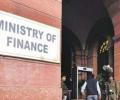
The finance ministry on Wednesday reimposed expenditure curbs on ministries and government departments for July-September quarter. There will be no spending restrictions on the ministries of health, rural development, agriculture, MSME (micro, small and medium enterprises) and railways as part of a two-pronged strategy. "The existing guidelines for expenditure control have been reviewed. "Keeping in view the evolving situation arising out of Covid-19 and anticipated cash position of the government, it is felt essential to regulate Quarterly Expenditure Plan (QEP)/Monthly Expenditure Plan (MEP) of specific ministries/departments for July-September, 2021," the Department of Economic Affairs in the finance ministry said in a notification.

Let's wait for the monetary policy on February 8 -- to see how it complements the fiscal commitments, points out Tamal Bandyopadhyay.

'The financial sector will be hit even harder than the overall market.' 'The banking sector will eventually be rescued.' 'But it may go into a long downwards spiral before things turn around.' 'Threat or buying opportunity?' asks Devangshu Datta.

Former RBI governor R Gandhi said that the RBI needs to re-introduce a one-time restructuring package and mere moratoriums will not suffice in unprecedented times like the COVID-19 pandemic.

Days after their passage in the Lok Sabha, Tomar introduced the Farmer's Produce Trade and Commerce (Promotion and Facilitation) Bill, 2020, and the Farmers (Empowerment and Protection) Agreement of Price Assurance and Farm Services Bill, 2020 in the Rajya Sabha.
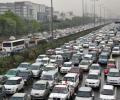
Auto sector has nothing to look forward to in the Budget.

The meeting with the top officials of public sector banks is scheduled for March 5, a senior finance ministry official told PTI.

Banded under the All India Kisan Sangharsh Coordination Committee, which claims to be an umbrella body of 207 organisations of farmers and agricultural workers, thousands of farmers arrived in Delhi on Thursday, on trains, buses and other modes of transport. The AIKSCC was formed under the aegis of All India Kisan Sabha and other Left-affiliated farmers' bodies in June 2017, following protests by farmers in states such as Maharashtra and Madhya Pradesh for debt relief and remunerative prices. On Friday, they marched to Parliament demanding for loan waivers and increased remuneration. Adnan Abidi/Reuters was able to photograph different farmers participating in the rally. The one takeaway: They may all look very different, but their woes are all the same.

'In times of recovery, we may see a rural-urban divide with the urban pockets affected more by COVID-19, but the MFI business model should encourage banks to handhold them in this hour of crisis,' notes Tamal Bandyopadhyay.

'The corporate sector says by 2022 they will create 300 million jobs.' 'In the last 70 years we didn't do it, how will we do it in 5 years?' 'Only agriculture can bail out the economy. Unfortunately, it is not being looked into.'

Without strong storage facilities, bumper harvest has resulted in price crash

Over 3,500 police personnel have deployed as the farmers began their march from the Ramlila Maidan to Parliament at 10.30 am.

Over 10 million farmers have received Rs 2,000 crore under the flagship scheme says Virendra Singh Rawat.

As many as 116 farmers have committed suicide due to agrarian reasons so far this year, with maximum cases reported in Maharashtra, followed by Punjab and Telangana.

The area-based income compensation scheme says that farmers should be paid the difference between the actual price they get and the state-mandated MSP. The compensation will be determined on a per acre basis by using district-level estimates of marketable surplus and prices in the harvest season.

Reserve Bank of India Governor Shaktikanta Das on Friday said the central bank will ensure adequate liquidity in the system to ease the financial stress caused by the Covid-19 pandemic. The central bank reduced the reverse repo rate -- the rate at which banks park their fund with the central bank -- by 25 basis points to 3.75 per cent.

'Till now, we were under tremendous stress. The economy was not recovering, the financial cycle was not moving and the banks were not supporting.' 'With the government pumping in money to the banks and asking the NBFCs to give priority to the MSME sector, there will be a revival.'

GST rate cut for real-estate, income transfer scheme, farm loan waivers execution and recapitalisation of PSU banks have the potential to boost India's growth in a few months, says Neelkanth Mishra.
